
Mystery Dumpling: Squishy Box
Brocker Bus StudioCasual
0.00.00 Reviews
- Version
- 0.7
- Installs
- 50.00K
- Age Rating
- Everyone
Screenshots


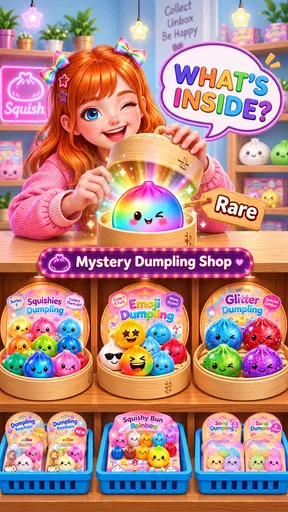




Our Review of Mystery Dumpling: Squishy Box
 Analysis by Appyee
I spent time with Mystery Dumpling: Squishy Box as a small, relaxed casual game built around opening mystery boxes and collecting soft-looking dumpling characters. Its appeal is immediate: each opening promises a new little surprise, while the collection gives the activity a reason to continue. I found it easiest to enjoy in short sessions rather than as a game demanding long concentration, and that makes it a natural fit for quiet breaks, waiting rooms, or a few minutes before bed.
The game is made by Brocker Bus Studio and is free to play. It is listed for Everyone, which matches the gentle presentation and simple premise. The current release is version 0.7, and it requires Android 8.0 or later. With more than 50K installs, it already has a modest audience, although it feels like a project that is still developing rather than a huge, fully established collection game.
How clearly the game communicates what to do
The central idea is easy to understand without a tutorial-heavy introduction. I could approach the experience as a simple loop: open a box, see which dumpling appears, and keep track of the growing set. That clarity matters for younger players and for anyone who does not want to learn complicated rules before enjoying a casual game.
The strongest part of the design is the immediate connection between action and reward. A box suggests curiosity, the opening supplies a small moment of suspense, and the dumpling gives the result a memorable shape. The theme does much of the explanatory work, so the player does not need specialist knowledge or experience with competitive games.
Readability is more than large text, though, and this is where I would pay attention during longer sessions. Collection games can become visually busy once several characters, buttons, and reward elements are on screen. I found it useful to pause after each discovery and look at the result rather than tapping quickly through the sequence. That habit makes it easier to notice what was collected and reduces the chance of treating every screen as one large, indistinct group of decorations.
For a child, a first-time player, or someone who prefers predictable interfaces, the limited premise is a benefit. There are fewer systems to remember than in a typical role-playing game, and the objective does not depend on reading a long story. On the other hand, players who need very explicit instructions may still want an adult or friend nearby at the beginning, especially if they are unfamiliar with collection games and do not immediately recognize which visual element advances the activity.
I also think the game works best when approached as a visual toy rather than a deep strategy title. The collection is the motivation, not a complicated puzzle layered on top of it. That distinction helps set expectations: if you want a calm surprise-and-collect experience, the presentation is approachable; if you expect detailed explanations, extensive menus, or a long-term competitive plan, the simplicity may feel limiting.
Practical reading habits that make the collection easier to follow
One useful approach is to slow down at the collection screen and treat it as a catalog rather than merely a reward popup. Looking at the whole set after several openings can make the progress feel more meaningful and helps separate newly discovered characters from familiar ones. I would also recommend using the device at a comfortable brightness instead of relying on maximum brightness, since bright decorative art can become tiring during repeated openings.
Another small but worthwhile habit is to keep the game in a stable orientation and avoid playing while walking. Mystery games depend on noticing the reveal, and a hurried glance can make the most interesting part pass unnoticed. This is not a demanding title, so giving each opening a moment of attention improves the experience more than trying to maximize speed.
Motor and sensory considerations during play
The basic interaction feels suitable for players who prefer simple taps over demanding gestures. There is no reason to approach the game expecting rapid combat controls, precision aiming, or complex combinations. That makes it more approachable for casual users and for people who find action-oriented mobile games tiring.
Still, simple tapping is not automatically comfortable for everyone. Repeated taps can be uncomfortable for players with limited hand strength, tremors, joint pain, or fatigue. In that situation, I would play in brief intervals and rest between openings rather than trying to complete a large part of the collection in one sitting. A phone stand can also help by reducing the need to grip the device continuously.
The visual theme is one of the game’s main attractions: cute dumplings, box-opening moments, and collectible surprises create a soft, playful mood. That can be welcoming for players who dislike aggressive competition or darker game worlds. It may be less comfortable for someone sensitive to repeated animations, sudden visual changes, or busy reward screens. Because the experience is built around anticipation and reveal, the screen can feel more stimulating than the calm premise initially suggests.
Sound deserves the same practical attention. I would begin with the device volume low and raise it only if the audio feels comfortable. This is especially sensible when playing around other people, during a commute, or in a shared bedroom. A player who is sensitive to sound can use the game silently if the device controls allow that, but the exact in-game audio options should be checked directly on the installed version rather than assumed.
For children, the cute style lowers the intimidation factor, but the mystery-box structure is worth discussing. Some children enjoy surprise collections without becoming overly focused on completing them; others may feel frustrated when the desired character does not appear quickly. I would frame each session as a small activity, not a challenge that must be finished. That keeps the emphasis on discovery instead of turning the collection into a source of pressure.
Players with color-vision differences may also want to observe whether they can distinguish every dumpling and collection state comfortably. Cute collection games often communicate through color as well as shape, and I would not rely on color alone when identifying progress. If two items look too similar, enlarging the device display through system settings may help, provided the enlarged layout remains usable.
Why the low-pressure format can be useful
In my experience, the game’s best inclusive quality is its lack of urgency. I can put it down after one opening without feeling that I have missed a timed battle or let a team down. That makes it a reasonable choice for someone whose attention varies during the day, including a player who needs frequent breaks or prefers to divide entertainment into very small pieces.
A realistic use case would be a short afternoon pause between errands. I could sit down, open a few boxes, inspect the new dumpling, and stop when concentration starts to fade. The game does not need to become the main event. That flexibility is more valuable than it may sound, particularly for players who find long sessions physically or mentally tiring.
The trade-off is that a player seeking strong feedback from every action may find the loop repetitive. The gentle format removes much of the pressure, but it also removes the excitement of mastery found in a platformer, puzzle game, or competitive match. Accessibility in one context can feel like a lack of depth in another.
Situational access on different days and in different places
Mystery Dumpling: Squishy Box fits quiet environments better than situations requiring constant awareness. I would use it while seated, with both the screen and my attention available. It is less suitable while crossing streets, standing on a crowded train, cooking, or doing anything where looking away from the surroundings creates a risk.
The short-session structure is helpful when energy is limited. A player can decide in advance to make only a few openings, which creates a natural stopping point. This is also a good approach for parents or caregivers who want a simple activity that can be paused easily. The game’s casual identity makes it less demanding than a title that penalizes interruptions or expects a long uninterrupted match.
At the same time, a free game is not automatically free from practical concerns. Families should still supervise how children use the device and review the experience themselves before handing it over for independent play. The mystery-box presentation can encourage “one more try” behavior, so setting a time boundary is sensible even when the game feels harmless and cheerful.
The Android requirement is relatively accommodating for people using older phones, since Android 8.0 is enough to run the listed version. That does not guarantee identical performance on every device, however. Screen size, touch responsiveness, and general device condition can change how comfortable the game feels. On a smaller display, tiny collection details may be harder to inspect; on an older handset, any delay between a tap and the reveal could make the interaction feel less smooth.
For shared spaces, I would treat the game as a visual activity first. Keeping the volume low avoids disturbing others, and playing while seated makes it easier to focus on the reveal. If you are using it during a break at school or work, the compact loop is convenient, but the bright, playful screen may draw attention more readily than a plain utility app.
The game can also work as a social activity without requiring multiplayer. I enjoyed the idea of passing the phone to a friend or child and letting each person guess what might appear next. That changes the experience from solitary collecting into a small shared ritual. It is important not to present guesses as promises, though: the fun comes from surprise, not from guaranteeing a particular dumpling.
Where the inclusive experience still has limits
The biggest limitation is that the game’s accessibility is mostly a result of simplicity, not clearly communicated customization. Simple controls and a friendly theme help many people, but they do not replace options for text size, contrast, animation control, input assistance, or alternative feedback. Players who depend on those tools should test the installed game carefully and use the operating system’s available adjustments where they help.
Another barrier is the collection loop itself. Repetition can be soothing for one player and exhausting for another. If you have difficulty with uncertainty, random-feeling rewards may be more frustrating than relaxing. If you need a clear route to a specific goal, a puzzle with fixed solutions or a creative game with direct control may be a better choice.
There is also a difference between age suitability and universal suitability. An Everyone rating indicates a broad audience, but it does not mean every child will respond well to surprise-based collecting, nor does it guarantee that every adult will find the visual presentation comfortable. I would judge the game by the individual player’s tolerance for repetition, sensory stimulation, and incomplete collections.
Players who want a substantial progression system should approach with caution. The attraction here is the small reveal and the charm of the dumplings, not a demanding campaign. Compared with a conventional casual puzzle game, this title offers less emphasis on solving and more on anticipation. Compared with a larger collection game, it feels easier to pick up but potentially less satisfying for someone who wants layered goals, elaborate planning, or a highly developed world.
The early version number also shapes my expectations. Version 0.7 suggests a product still in active development, so I would not judge it by the same standard as a mature, content-heavy game. For some players, that lighter state is appealing because the experience is easy to understand. For others, it may mean the available variety does not yet provide enough reason to return every day.
Who should install it, and who should choose something else?
I would recommend it to players who like cute collectibles, brief surprise-driven activities, and games that can be enjoyed without learning a complicated rule set. It is particularly suitable for a relaxed break, a child-friendly shared activity, or anyone who prefers tapping through a small collection rather than competing against other players.
I would skip it if your priority is strategic depth, fixed objectives, fast action, or a strong story. I would also choose a different casual game if random discovery makes you anxious or if repeated visual reveals are tiring. A puzzle game with predictable solutions is likely better for someone who wants control over every outcome, while a creative sandbox may suit a player who wants to make rather than collect.
Before recommending it to a child, I would play alongside them once and see how they react when a preferred dumpling does not appear. That single observation tells you more than the cheerful artwork does. If they enjoy the reveal and can stop comfortably, the game can be a pleasant shared pastime. If they immediately feel compelled to continue, a fixed-session routine or another type of game may be healthier.
My inclusive verdict after using the game
Mystery Dumpling: Squishy Box succeeds because it understands the value of a tiny, friendly interaction. Opening a box and meeting a new dumpling is easy to grasp, and the game avoids the physical demands of action-heavy mobile titles. Its free price and Everyone rating make it approachable for a broad audience, while support for Android 8.0 or later gives it a practical place on older compatible devices.
My recommendation comes with a clear condition: treat it as a short-form collection toy, not as an expansive game. Its strongest qualities are the gentle theme, low-pressure pacing, and suitability for small moments of attention. Its weaker side is the possibility of repetition, sensory fatigue, and limited control for players who need highly configurable interfaces or dislike uncertain rewards.
The best way to enjoy it is to keep sessions intentional: play while seated, lower the volume if needed, pause between reveals, and stop before the collection turns into a chore. With that approach, the game can be welcoming across several everyday contexts without pretending to solve every accessibility need.
For me, Brocker Bus Studio has created a pleasant casual experience with a clear identity. I would suggest it to a friend who enjoys cute discoveries and wants something uncomplicated for short breaks. I would not suggest it to someone asking for deep gameplay or complete accessibility customization. That balanced expectation is the key to getting the most from Mystery Dumpling: Squishy Box: enjoy the small surprises, judge the sensory and motor demands personally, and let the dumplings remain a light diversion rather than a commitment.
Verdict
Strengths of Mystery Dumpling: Squishy Box
- Relaxing squishy interactions are easy to learn and enjoy.
- Cute dumpling designs make the game visually appealing.
- Short play sessions suit quick breaks.
- Simple controls work well on touchscreen devices.
- Collecting different characters adds a light progression goal.
Limitations of Mystery Dumpling: Squishy Box
- Gameplay may feel repetitive after the initial novelty fades.
- Some content may require watching ads or making purchases.
- Limited challenge could disappoint players seeking deeper gameplay.
- Frequent sound effects may become distracting over time.
- Progression offers little variety for long-term players.
Other Releases by Brocker Bus Studio
View All
Mystery Dumpling: Unbox ASMR
Casual4.8

Monster Remix Beat Maker
Music3.2
Similar Picks in This Category
View All
My Talking Angela
Outfit7 Limited4.2

My Talking Tom
Outfit7 Limited4.3

Pou
Zakeh4.2

My Talking Tom 2: Pet Game
Outfit7 Limited4.3

Candy Crush Saga
King4.6

Bridge Race
Supersonic Studios LTD4.1
Frequently Asked Questions
What is Mystery Dumpling: Squishy Box?
Mystery Dumpling: Squishy Box is a casual collection and surprise-opening game centered around adorable dumpling-shaped characters. You open virtual boxes, discover random squishy figures, and build a collection of different designs. The experience is designed to be relaxing and simple, with cute visuals, short play sessions, and a focus on curiosity rather than complex strategy or demanding controls.
How do you play Mystery Dumpling: Squishy Box?
Gameplay is easy to understand, even if you have never played a mystery-box or collectible game before. You generally select or open boxes, reveal the dumpling hidden inside, and add the discovered character to your collection. Depending on the available activities, you may also interact with the figures, review your collection, and continue opening new boxes to find designs you have not collected yet.
Is Mystery Dumpling: Squishy Box free to download and play?
The game can generally be downloaded without an upfront purchase, allowing players to try its main features before spending anything. However, free-to-play games may include optional advertisements, in-app purchases, or systems that limit how quickly you can open additional boxes. Before confirming a purchase, check the store listing and the payment settings on your Android or iOS device.
Does Mystery Dumpling: Squishy Box require an internet connection?
An internet connection may be needed for certain functions, such as loading advertisements, synchronizing progress, updating game content, or processing optional purchases. Some basic interactions may work when the device is offline, but availability can vary by version and platform. If you plan to play while traveling, it is worth testing the game offline first rather than assuming every feature will remain accessible.
Is Mystery Dumpling: Squishy Box suitable for children?
The cute presentation and straightforward mechanics make Mystery Dumpling: Squishy Box appealing to younger players, but parents should still review the game’s age rating and store information before installation. Mystery-box mechanics can resemble randomized rewards, and the app may include advertising or optional purchases. It is advisable to enable parental controls and require approval for purchases if children will use the device.
Play our best games!


